
→ Related: Signs of Hormonal Imbalance in Women: 10 Symptoms You Shouldn’t Ignore
→ Related: How to Balance Hormones Naturally: 6 Strategies That Are Actually Backed by Evidence
→ Related: Perimenopause Symptoms: 12 Signs & Proven Ways to Manage Them
Cortisol and weight gain have a direct, documented biological relationship — and it’s one of the most misunderstood drivers of the weight that doesn’t respond to diet or exercise. You eat carefully. You move your body. The number on the scale barely shifts, or the fat keeps appearing around your middle regardless of what you do. What’s happening isn’t a failure of willpower. It’s a hormonal override.
Cortisol is your body’s primary stress hormone. In short bursts, it’s essential — it mobilises energy for a crisis, sharpens alertness, and prepares you to respond to a threat. The problem is that the human stress response was designed for acute, short-term threats. It was not designed for the kind of sustained, low-level stress that defines modern life: chronic work pressure, poor sleep, financial anxiety, relationship strain, and the relentless stimulation of screens and notifications. When the stress response stays switched on, cortisol stays elevated — and a cascade of metabolic consequences follows.
Cortisol and Weight Gain — Key Facts
Abdominal fat has more glucocorticoid receptors: visceral fat tissue is more responsive to cortisol than subcutaneous fat, which is why chronic stress specifically promotes abdominal weight gain rather than overall body weight gain.
Cortisol raises blood sugar: by design, cortisol increases glucose availability during stress. Chronically elevated cortisol means chronically elevated blood sugar — which means chronically elevated insulin.
Cortisol suppresses thyroid function: chronic cortisol elevation inhibits the conversion of T4 to the active T3 thyroid hormone, slowing metabolism independently of calorie intake.
The cycle is self-reinforcing: visceral fat itself produces inflammatory cytokines that activate the HPA axis, driving more cortisol production. Cortisol drives more fat storage. The cycle compounds.
What Cortisol Actually Does
Cortisol is produced by the adrenal glands in response to signals from the hypothalamus-pituitary-adrenal (HPA) axis. Under normal conditions, it follows a predictable diurnal rhythm: peaking sharply within 30–45 minutes of waking to provide morning energy and alertness, then tapering steadily through the day to allow melatonin to rise and facilitate sleep at night.
Acutely, cortisol does exactly what it’s supposed to do. It releases stored glucose from the liver, suppresses non-essential functions like digestion and reproduction, increases heart rate and blood pressure, sharpens focus, and mobilises fat from storage for immediate energy. This is the fight-or-flight response — a remarkable, finely tuned physiological system.
The problem is duration. Under chronic stress, the HPA axis remains activated. The cortisol curve flattens — instead of a sharp morning peak and gentle decline, levels stay elevated through the day and evening, disrupting sleep and preventing the hormonal reset that happens overnight. When this pattern persists for weeks and months, the metabolic consequences become measurable.
💡 The diurnal rhythm matters as much as the level: a woman with ‘normal’ average cortisol but a flat, dysregulated curve — elevated at night, blunted in the morning — can experience the same weight-gain effects as someone with clinically elevated cortisol.
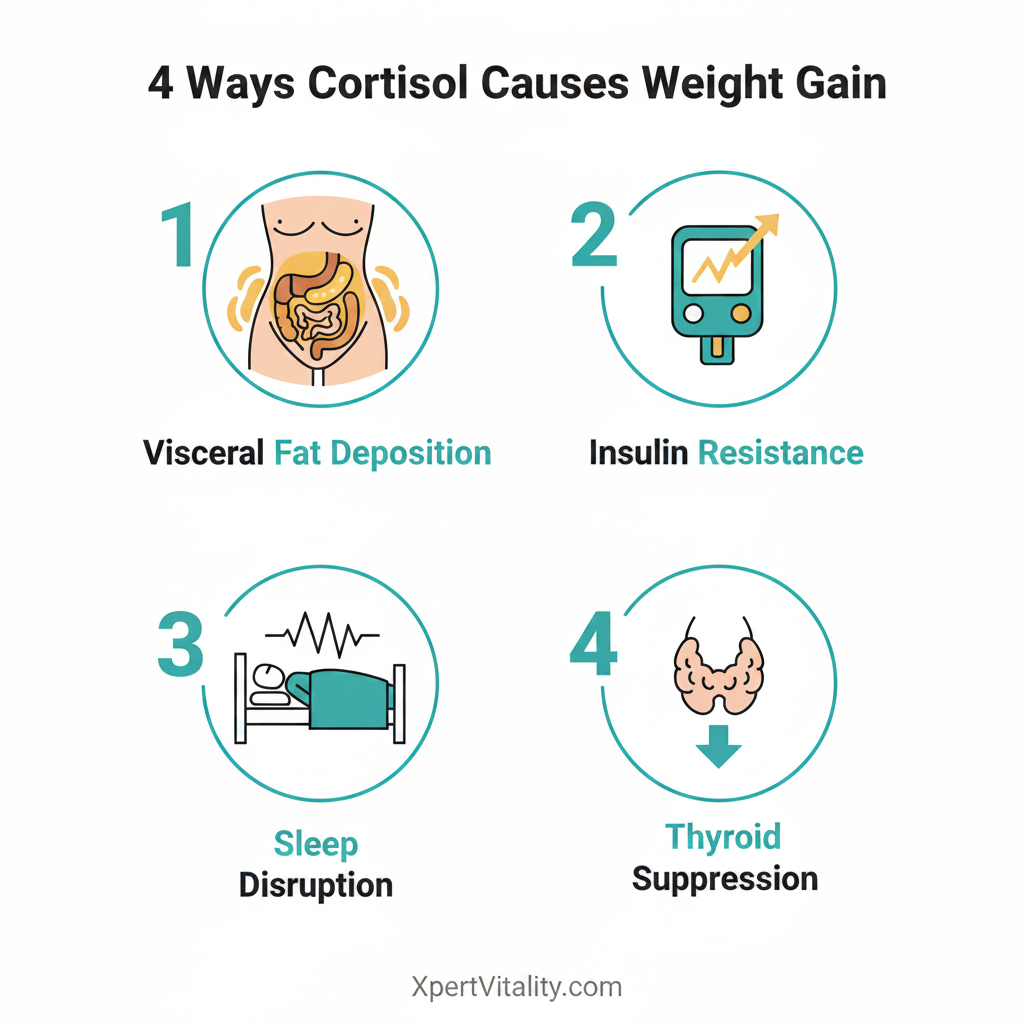
How Cortisol and Weight Gain Are Connected — 4 Mechanisms
🪫 Direct visceral fat deposition: Visceral adipose tissue — the fat that accumulates inside the abdominal cavity around the organs — has a significantly higher density of glucocorticoid receptors than subcutaneous fat. This means it is more sensitive to cortisol’s fat-storage signal. When cortisol is chronically elevated, it activates these receptors and promotes the preferential deposition of fat in the abdominal region. Research published in Psychosomatic Medicine found that women with higher waist-to-hip ratios secreted significantly more cortisol in response to stress than women with lower ratios — confirming the direct relationship between cortisol reactivity and abdominal fat distribution.
🩸 Insulin resistance and blood sugar dysregulation: Cortisol raises blood glucose by triggering the liver to release stored glucose (gluconeogenesis) and by reducing glucose uptake in muscle cells. This is appropriate during an acute crisis — you need available fuel. Under chronic stress, this means persistently elevated blood sugar, which forces the pancreas to produce more insulin. Over time, cells become less responsive to insulin’s signal — insulin resistance develops. Research published in the International Journal of Molecular Sciences confirmed the molecular mechanisms by which glucocorticoids induce insulin resistance across adipose tissue, liver, and skeletal muscle. Insulin resistance then compounds the weight-gain problem by directing more glucose into fat storage.
💤 Sleep disruption and the appetite hormone cascade: Chronically elevated cortisol — particularly the flat, dysregulated cortisol curve that keeps levels high in the evening — directly impairs sleep quality. Poor sleep raises ghrelin (the hunger hormone) and lowers leptin (the satiety hormone). The practical result: increased hunger, reduced fullness signals, and a specific preference for high-calorie, high-sugar foods that provide rapid cortisol relief. This is not a lack of willpower. It is a neuroendocrine response. Sleep deprivation also independently raises cortisol the following day, creating a compounding cycle where poor sleep generates more stress, which generates more cortisol, which further disrupts sleep.
🐢 Thyroid suppression and metabolic slowdown: Cortisol inhibits the conversion of T4 (the inactive thyroid hormone produced by the thyroid gland) into T3 (the active form that drives cellular metabolism). It also increases reverse T3 — an inactive thyroid hormone that competes with T3 at receptor sites. The result is effectively a slowed metabolism: cells receive less thyroid signal, energy expenditure drops, and weight loss becomes harder — even in people with nominally ‘normal’ thyroid lab results. This mechanism is why women under chronic stress can have all the symptoms of hypothyroidism while their TSH appears normal.
How to Tell If Cortisol Is Driving Your Weight Gain
Cortisol-driven weight gain has a specific pattern that distinguishes it from simple calorie-driven weight gain. Not all of these need to be present, but the combination is characteristic.
- Weight accumulating specifically around the abdomen and mid-back — not distributed across the body
- Weight that doesn’t respond to calorie restriction or increased exercise
- Sleep disruption — particularly the 2–4am waking pattern
- Fatigue that doesn’t improve with more rest — waking tired despite adequate hours
- Cravings for sweet or salty foods, particularly in the evening
- Mood instability, anxiety, or low motivation
- Puffiness or fluid retention, particularly in the face
- Low libido and reduced tolerance for exercise intensity
ℹ Blood tests that can help: 24-hour urinary free cortisol, salivary cortisol at 4 time points across the day (to assess the diurnal curve, not just a single level), morning serum cortisol, and a full thyroid panel including free T3 and reverse T3. A single morning cortisol reading is insufficient to assess cortisol dysregulation.
The Cortisol and Weight Gain Cycle — Why It’s Self-Reinforcing
One of the most clinically significant aspects of the cortisol-weight relationship is that it becomes self-perpetuating. Visceral fat is metabolically active — it produces inflammatory cytokines (particularly IL-6 and TNF-alpha) that directly activate the HPA axis, driving more cortisol secretion. More cortisol drives more visceral fat deposition. More visceral fat drives more cortisol. Without intervention, the cycle compounds.
This is why lifestyle approaches alone often fail for cortisol-driven weight gain. Calorie restriction increases cortisol (the body interprets food restriction as a threat). High-intensity exercise raises cortisol significantly in already-stressed individuals. Late-night eating disrupts the cortisol curve. Each of these common ‘weight loss’ strategies can inadvertently worsen the hormonal driver of the problem.
💡 The intervention that works is not the intervention for standard weight gain. It’s the intervention that reduces cortisol — which then allows the metabolic machinery to function normally again.

How to Address Cortisol and Weight Gain
1. Prioritise Sleep Above All Other Interventions
The cortisol-weight cycle is most effectively broken at the sleep point. Restorative sleep resets the HPA axis, normalises the cortisol diurnal curve, and restores leptin and ghrelin balance simultaneously. A consistent wake time — not bedtime — is the most powerful anchor for circadian cortisol regulation. Keep it within 30 minutes seven days a week.
Magnesium Glycinate: supports GABA activity and melatonin synthesis. Both are directly suppressed by elevated cortisol. 200–400mg at night supports the hormonal shift from cortisol-dominant evening into restorative sleep.
⚠ Magnesium caution: use with caution in chronic kidney disease (CKD) — impaired kidneys cannot excrete excess magnesium efficiently and toxicity can occur. Do not exceed 400mg elemental magnesium daily from supplements without medical guidance. Magnesium interacts with several medications: it can reduce absorption of certain antibiotics (tetracyclines, fluoroquinolones), reduce effectiveness of bisphosphonates, and have additive effects with diuretics. Separate magnesium supplementation from these medications by at least 2 hours. Discuss with your doctor or pharmacist if you take any prescription medication.
Our pick: Doctor’s Best High Absorption Magnesium Glycinate — 100% chelated TRAACS form · highest bioavailability · 200mg elemental magnesium per tablet · gentlest on the stomach. Shop Now →
Our pick: Natural Vitality CALM Magnesium Citrate — Magnesium citrate powder · mixes into warm water before bed · non-GMO · vegan · fast-absorbing. Shop Now →
2. Move in Ways That Lower Cortisol, Not Raise It
For women with cortisol-driven weight gain, high-intensity exercise is counterproductive — it raises cortisol significantly and compounds the hormonal disruption. The exercise that lowers cortisol is moderate-intensity, consistent, and ideally outdoors. Walking is not a consolation prize. Multiple RCTs show it reduces cortisol more effectively than equivalent indoor exercise. 20–40 minutes daily, ideally in natural environments without screens.
Strength training 2–3 times per week is valuable for insulin sensitivity and muscle preservation, but intensity should be moderate. The goal is a training stimulus that improves metabolic function, not a training load that triggers additional cortisol output.
3. Stabilise Blood Sugar at Every Meal
Cortisol and insulin resistance create a blood sugar environment that is primed for fat storage. Stabilising blood sugar directly interrupts this. The practical approach: protein and healthy fat at every meal (including breakfast), no skipping meals, and reducing refined carbohydrates and added sugar that create cortisol-compounding blood sugar spikes.
This is not low-carb eating. It’s strategic pairing — never eating carbohydrates alone, always with protein or fat to slow glucose absorption and blunt the insulin response.
4. Ashwagandha KSM-66 for Direct HPA Axis Modulation
For cortisol-driven weight gain specifically, ashwagandha KSM-66 is the most clinically supported adaptogen. Multiple RCTs show 14–27% reductions in serum cortisol after 8 weeks of consistent use at 600mg daily. The mechanism is HPA axis modulation — it reduces the ceiling on cortisol reactivity rather than suppressing the stress response entirely.
⚠ Ashwagandha is contraindicated in pregnancy and breastfeeding. Use with caution if you have thyroid conditions, autoimmune disease, or active liver disease. Interacts with thyroid medications, immunosuppressants, and sedatives. Discuss with your doctor before starting.
Our pick: Nutricost KSM-66 Ashwagandha 600mg — Standardised KSM-66 root extract · 5% withanolides · BioPerine for absorption · GMP certified · 600mg per capsule. Shop Now →
5. Omega-3 to Reduce Neuroinflammation and Cortisol Reactivity
EPA and DHA omega-3 fatty acids have documented effects on HPA axis reactivity — supplementation reduces cortisol response to psychological stressors in multiple trials. They also reduce the systemic inflammation that visceral fat produces, addressing both ends of the self-reinforcing cycle. 2–3g EPA+DHA daily from IFOS-certified fish oil.
⚠ Omega-3 caution: at doses of 2–3g EPA+DHA daily, omega-3 fatty acids have mild antiplatelet (blood-thinning) properties. Consult your doctor before use if you take anticoagulant or antiplatelet medications (such as warfarin, aspirin, or clopidogrel), have a diagnosed bleeding disorder, or are scheduled for surgery. Do not exceed recommended doses without medical supervision.
Our pick: Nordic Naturals Ultimate Omega — IFOS 5-star certified · 1280mg EPA+DHA per serving · triglyceride form for superior absorption. Shop Now →
When to See a Doctor About Cortisol and Weight Gain
Lifestyle interventions address the cortisol-weight gain cycle effectively for stress-driven dysregulation. They don’t address clinical conditions. See a doctor if:
- Abdominal weight gain is rapid and not explained by dietary changes
- You have other Cushing’s syndrome symptoms: rounded face, purple stretch marks, easy bruising, thin skin, or muscle weakness in the upper arms and legs
- You take or have recently taken corticosteroid medications (prednisone, dexamethasone, or similar) — these raise cortisol pharmacologically
- Symptoms are severe, worsening, or significantly affecting daily function
- Standard lifestyle changes haven’t produced any improvement after 8–12 weeks of consistent effort
ℹ Cushing’s syndrome — clinically elevated cortisol from a tumour or adrenal disorder — is rare but produces the same pattern of abdominal fat accumulation as stress-induced cortisol elevation, with additional features. Clinical evaluation rules it out and clarifies the path forward.
Frequently Asked Questions
Can cortisol directly cause weight gain?
Yes — through four specific mechanisms: direct visceral fat deposition (abdominal adipose tissue has more glucocorticoid receptors and responds more strongly to cortisol), insulin resistance (cortisol raises blood glucose and promotes insulin resistance in muscle and liver), sleep disruption that raises hunger hormones, and suppression of active thyroid hormone conversion. The relationship between cortisol and weight gain is documented at the molecular level.
Why does stress cause belly fat specifically?
Because visceral adipose tissue — the fat inside the abdominal cavity around the organs — has a significantly higher density of glucocorticoid receptors than subcutaneous fat elsewhere on the body. It is more sensitive to cortisol’s fat-storage signal. Chronic cortisol elevation therefore preferentially deposits fat in the abdominal region rather than distributing it evenly across the body.
Will losing weight lower cortisol?
The relationship goes both ways, but the evidence is clearer in the direction of reducing cortisol first. Approaches that directly reduce cortisol — improved sleep, stress management, HPA axis modulation — tend to make weight loss easier. Attempting to lose weight through calorie restriction and high-intensity exercise while cortisol remains elevated often compounds the problem, since both calorie restriction and intense exercise acutely raise cortisol.
How long does it take to lower cortisol naturally?
Sleep improvements can show measurable cortisol normalisation within 2–4 weeks of consistent sleep habits. Ashwagandha KSM-66 shows cortisol reductions at 4–8 weeks of consistent daily use. Sustained lifestyle changes — consistent sleep, moderate exercise, blood sugar stability, and stress management — produce progressive improvement over 2–3 months.
Can cortisol and weight gain be addressed without supplements?
Yes. The foundational interventions are lifestyle-based: sleep quality and consistency, stress management, moderate exercise, and blood sugar stabilisation. Supplements accelerate and support these changes but don’t replace them. For women with significant cortisol dysregulation, the lifestyle changes alone often produce meaningful improvement within 6–8 weeks.
Is cortisol-driven weight gain reversible?
Yes — the mechanisms are physiological, not structural. Visceral fat is metabolically active and responds to hormonal changes. As cortisol normalises, insulin sensitivity typically improves, appetite regulation returns, and the body becomes more willing to release stored abdominal fat. The timeline is weeks to months, not days — and it requires addressing the cortisol driver, not just the calorie balance


